David Swanson Awardee Saloni Bhogale Presents at HTC Week 2026
Sophie Dorros
Jun 30, 2026
Saloni Bhogale received the 2026 David Swanson Award at Throughput Computing Week 2026 (HTC26). The David Swanson Memorial Award is given to former OSG School students who have achieved significant research results powered by distributed high-throughput computing. The first David Swanson awardee whose research focused on political science, Bhogale is a UW-Madison Ph.D. candidate specializing in comparative politics and political methodology. At HTC26 Bhogale discussed her research utilizing throughput computing, “Justice at Scale: Leveraging High-Throughput Computing to Analyze Millions of Judicial Records.” Her research explored what determines the effectiveness of legal institutions in the developing world and their ability to achieve stated goals for the people they are meant to serve.
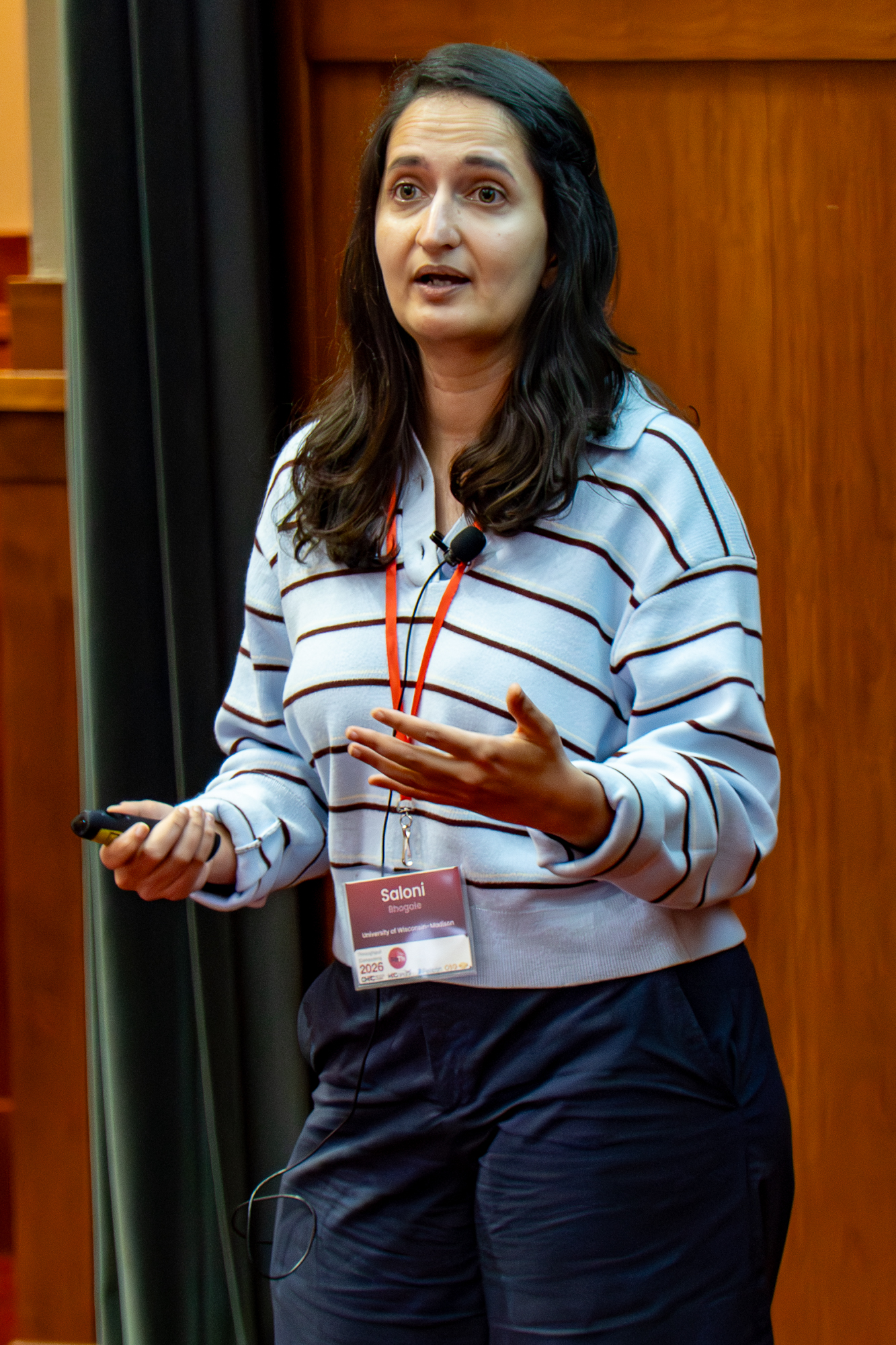
Bhogale observed that legal institutions in the developing world face two main challenges: accessing the courts is extremely hard, and complainants face massive delays within the courts system. Her research works to understand what can be done to solve these problems.
Bhogale's research required her to work with about 80 million electronic case records from the Indian government's website, which she initially attempted to run on laptops loaned from UW Libraries. After she calculated it would take 15 years to acquire all of the data she needed if she continued to process the data using loaned laptops, Bhogale turned to the Center for High Throughput Computing (CHTC) for help. Bhogale noticed a posting for the OSG School in 2023 citing transforming research with scaling out your computer, and knew it was "perfect" for her. After attending the OSG School in 2023, she was able to walk away with a prototype to execute the massive plan of assembling and working with 80 million case records to research legal institutions in India.
Bhogale shared summaries of two research projects in which she applied HTC resources towards different tasks. First, in her paper "Estimating Treatment Effect Heterogeneity with Varying Coefficients and Bayesian Tree Ensembles," Bhogale leveraged HTC to run simulation studies to test new statistical methods at the intersection of causal inference and machine learning. Bhogale ran jobs of varying complexities, methods, and sample sizes using Docker to bundle packages and execute 1000 runs of the same method and analyze the results. "The preliminary results show that our proposed method is both faster and leads to lower errors across these simulations that we were able to run on the HTC systems," noted Bhogale.
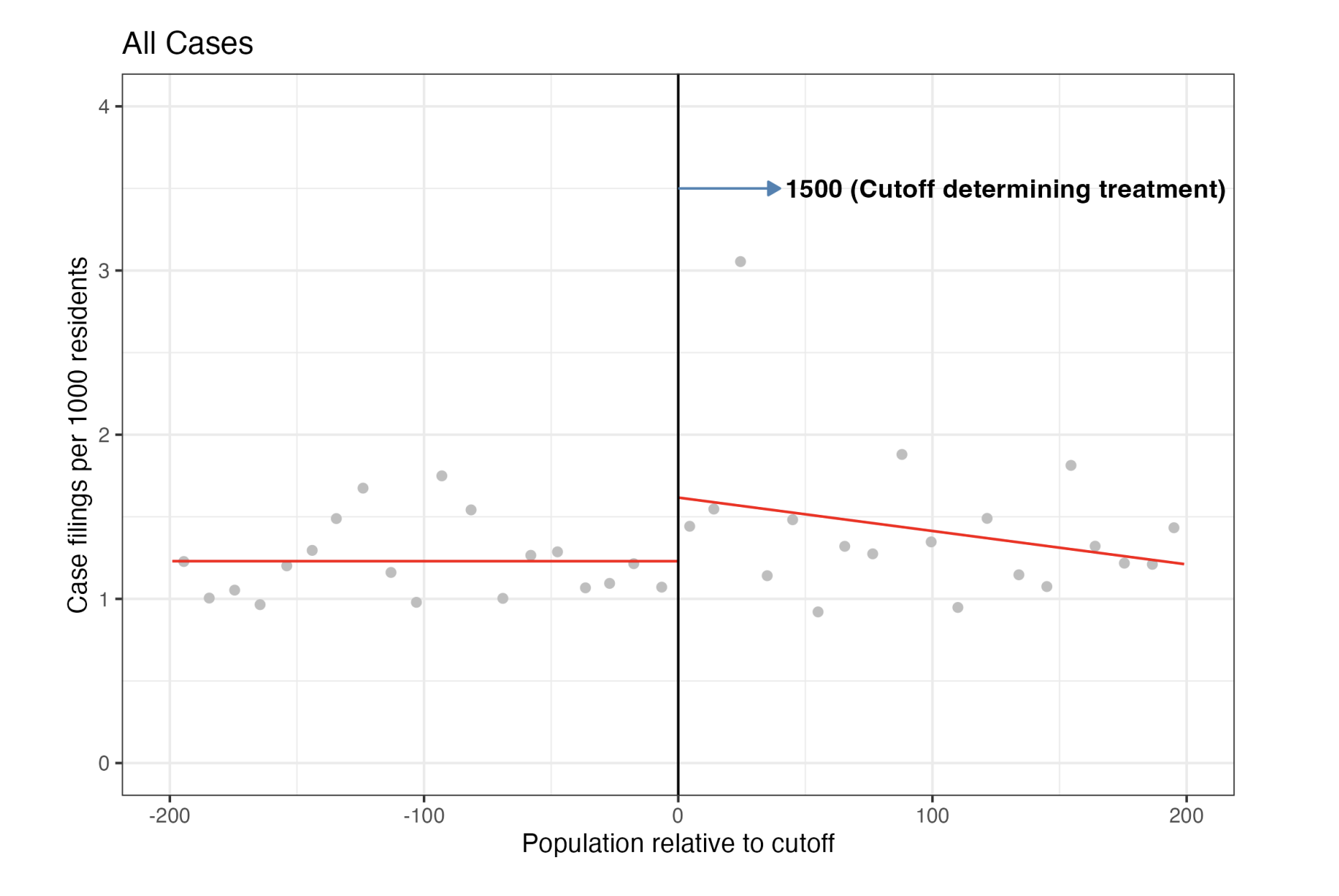
Substantively, through her HTC powered research, Bhogale found that case filings in a western state of India increased by 51% per two additional members in a village council, increasing the likelihood of people from different communities being able to access the justice system, a finding that shows how local democracies are linked to accessing legal systems. Bhogale noted that "social science research can be improved by leveraging HTC systems to work with large datasets and develop new methods. It has changed the scale of the work I am able to do." Bhogale's success in using HTC to answer how legal and justice systems in the developing world can be improved for citizens reflects how HTC can be implemented in all disciplines, including the social sciences.
The OSG Consortium runs the OSG School, an annual education event for researchers who want to learn how to use DHTC methods and tools. It is held each summer at the University of Wisconsin–Madison. Applications for OSG School 2027 open in February 2027 and typically close in mid-to-late March. Announcements about the 2027 OSG School will be posted here: https://osg-htc.org/community/school.html.